
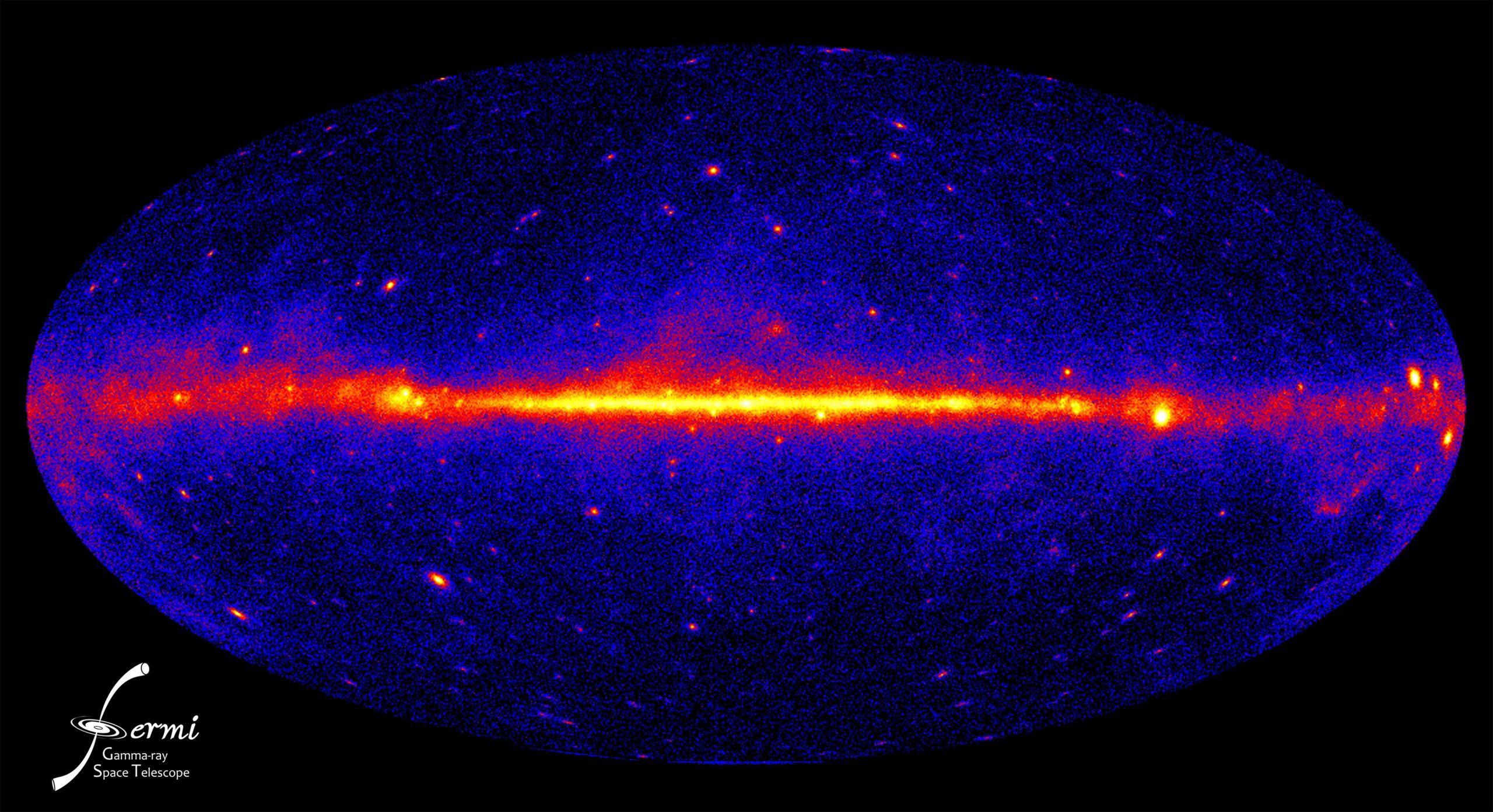
研究人员来自[{” attribute=””>Australian National University (ANU) have found an alternative explanation for a mysterious gamma-ray signal coming from the center of the galaxy, which was long claimed as a signature of dark matter.
Gamma-rays are the form of electromagnetic radiation with the shortest wavelength and highest energy.
Co-author of the study Associate Professor Roland Crocker said this particular gamma-ray signal — known as the Galactic Center Excess — may actually come from a specific type of rapidly-rotating neutron star, the super-dense stellar remnants of some stars much more massive than our sun.
The Galactic Center Excess is an unexpected concentration of gamma-rays emerging from the center of our galaxy that has long puzzled astronomers.
“Our work does not throw any doubt on the existence of the signal, but offers another potential source,” Associate Professor Crocker said.
“It is based on millisecond pulsars — neutron stars that spin really quickly — around 100 times a second.
“Scientists have previously detected gamma-ray emissions from individual millisecond pulsars in the neighborhood of the solar system, so we know these objects emit gamma-rays. Our model demonstrates that the integrated emission from a whole population of such stars, around 100,000 in number, would produce a signal entirely compatible with the Galactic Center Excess.”
The discovery may mean scientists have to re-think where they look for clues about dark matter.
“The nature of dark matter is entirely unknown, so any potential clues garner a lot of excitement,” Associate Professor Crocker said.
“But our results point to another important source of gamma-ray production.
“For instance, the gamma-ray signal from Andromeda, the next closest large galaxy to our own may be mostly due to millisecond pulsars.”
ANU Masters student Anuj Gautam led the research, which also involved scientists from The Australian Defence Force Academy, University of Canterbury, and University of Tokyo.
The research has been published in the journal Nature Astronomy.
Reference: “Millisecond pulsars from accretion-induced collapse as the origin of the Galactic Centre gamma-ray excess signal” by Anuj Gautam, Roland M. Crocker, Lilia Ferrario, Ashley J. Ruiter, Harrison Ploeg, Chris Gordon and Oscar Macias, 28 April 2022, Nature Astronomy.
DOI: 10.1038/s41550-022-01658-3

梅琳(Mei Lin)是 Eddiba.com 的撰稿作者,关注新闻、时事、政治、商业、科技、体育、娱乐及生活方式等领域。她致力于以清晰、准确且易于理解的方式报道重要事件,为读者提供实用资讯与最新动态。通过关注社会热点和与大众息息相关的话题,她持续分享具有参考价值和阅读意义的内容,帮助读者更好地了解不断变化的世界。




更多报道
中外联合考古取得新进展:跨越国界探寻文明交流印记
朱雀三号火箭新一轮发射任务受关注,重点验证一级垂直回收
美国科学家首次利用AI创造自然界不存在的病毒,引发基因安全讨论